 Cgpt
Cgpt
Cgpt AI credits fund ChainGPT requests at a fixed dollar value
Cgpt AI credits fund paid ChainGPT tools at a fixed value of $0.01 USD per credit. Each tool consumes credits according to its request type and enabled options. The credit unit stays predictable, while total usage costs depend on the workload, account plan and extras such as saved chat history.
UpdatedCredit balances connect purchases to paid requests
ChainGPT Credits, abbreviated CGPTc, measure the service balance available for metered AI work. A paid request draws from that balance using the charge assigned to its tool and options. The dashboard shows available credits, while API access uses an authenticated key associated with the account. Holding CGPT tokens in a wallet does not automatically create a spendable credit balance.
CGPT provides a token payment route, and direct credit purchases also support card or cryptocurrency payments. Staking serves a separate membership function. Its staking points establish eligibility for benefits such as a monthly AI allowance; they are not the units deducted for an ordinary paid request.
Token conversion commits funds to AI usage
Converting CGPT tokens into CGPTc is a one-way action. The conversion cannot be reversed to recover the original tokens. Choose the amount with the intended AI workload in mind, because the resulting balance represents service credits.
The token’s market value can change before conversion. Each resulting credit retains the platform’s fixed dollar denomination, so a token quantity and a credit quantity describe different purchasing units. A remembered token-to-credit ratio therefore does not establish the amount a new conversion will deliver.
The quoted token amount and credit amount define what the conversion commits to AI usage.
An account credit balance confirms available service funding. A wallet payment record concerns the payment itself. Keeping those records distinct matters when a purchase leaves the wallet but the corresponding credits have not appeared in the account.
How does the selected tool change credit consumption?
The selected tool determines whether usage is billed per request, per generated image or by blocks of requested records. The charge belongs to that operation, so a credit balance alone cannot tell you how many tasks remain. Read the tariff for the particular tool and access method, including any enabled extras.
Requests for answers and contract work
A chatbot answer, a Smart Contract Generator request and a Smart Contract Auditor request each have their own charging terms. Contract generation and auditing also produce different outputs, even when both accept a text prompt. An account budget should assign each operation its applicable charge. Optional history can change the total, and a new follow-up remains another request.
Images and optional enhancements
The AI NFT Generator meters image creation and offers optional enhancements with additional credit costs. Upscaling and prompt enhancement are separate cost inputs. Model selection also matters where an externally supplied model has a different tariff from the in-house models. A collection budget uses the intended image count and chosen enhancements.
News records and requested page size
The AI News API links credit consumption to the requested result limit. Larger requests use additional billable record blocks, with partial blocks rounded upward under its charging rule. Filters select the relevant news; they do not remove the request charge. Pagination can involve additional calls, so the bill depends on the page size and the calls made, not simply the number of useful headlines retained.
When does saved chat history add a charge?
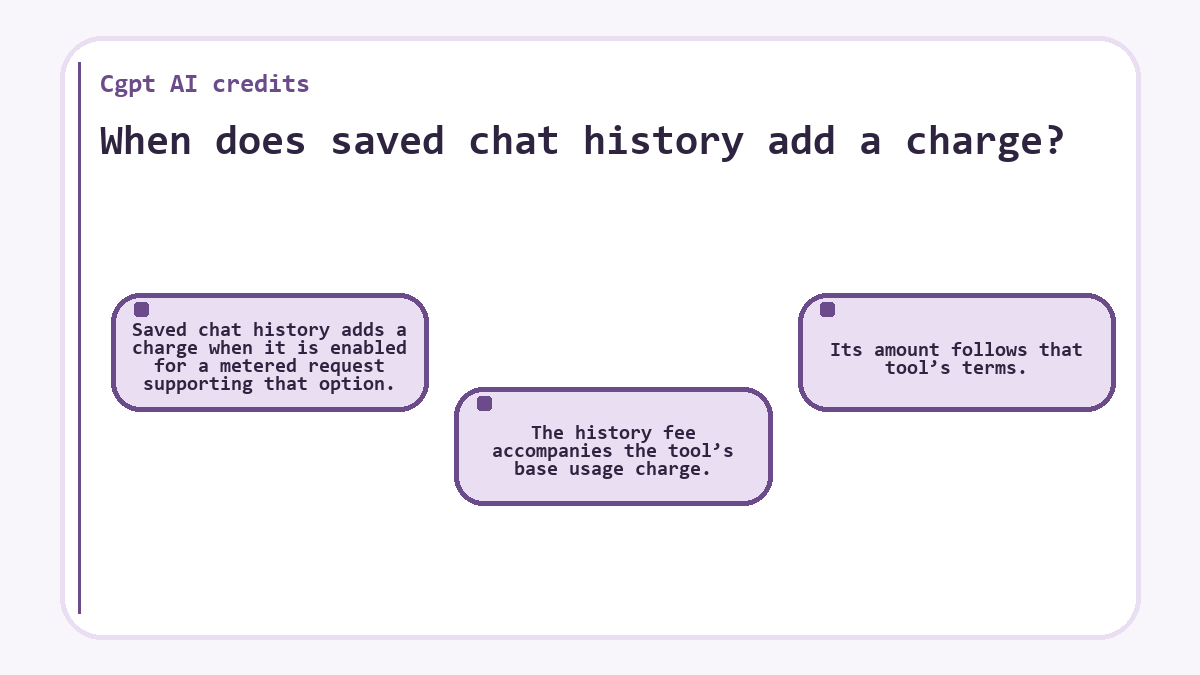
Saved chat history adds a charge when it is enabled for a metered request supporting that option. The history fee accompanies the tool’s base usage charge. Its amount follows that tool’s terms.
Memory for follow-up questions
With history enabled, the service stores the question and answer and can use previous exchanges in later replies. A consistent session identifier keeps the intended conversation together. Separate identifiers help avoid mixing unrelated threads under one API key. This setting also affects data handling: prompts and responses become saved conversation records, so sensitive material needs deliberate handling before submission.
Streaming changes delivery timing
The chatbot API supports streamed text and a buffered answer through the same underlying chat request. Streaming exposes text as it arrives; buffering presents the complete response afterward. The chatbot’s API charging model distinguishes saved history from these delivery choices. Other tools have their own options and tariffs, so a chatbot setting should not become a pricing assumption for every AI product.
Free access and Freemium supply different allowances
The Free plan offers specified no-cost uses, while Freemium supplies a monthly credit allowance for eligible Diamond members. Free access has tool-specific limits and does not establish unlimited free API usage. Pay-Per-Prompt provides a paid route for supported work beyond applicable free allowances. Directly purchasing credits does not require staking CGPT merely to access this usage model.
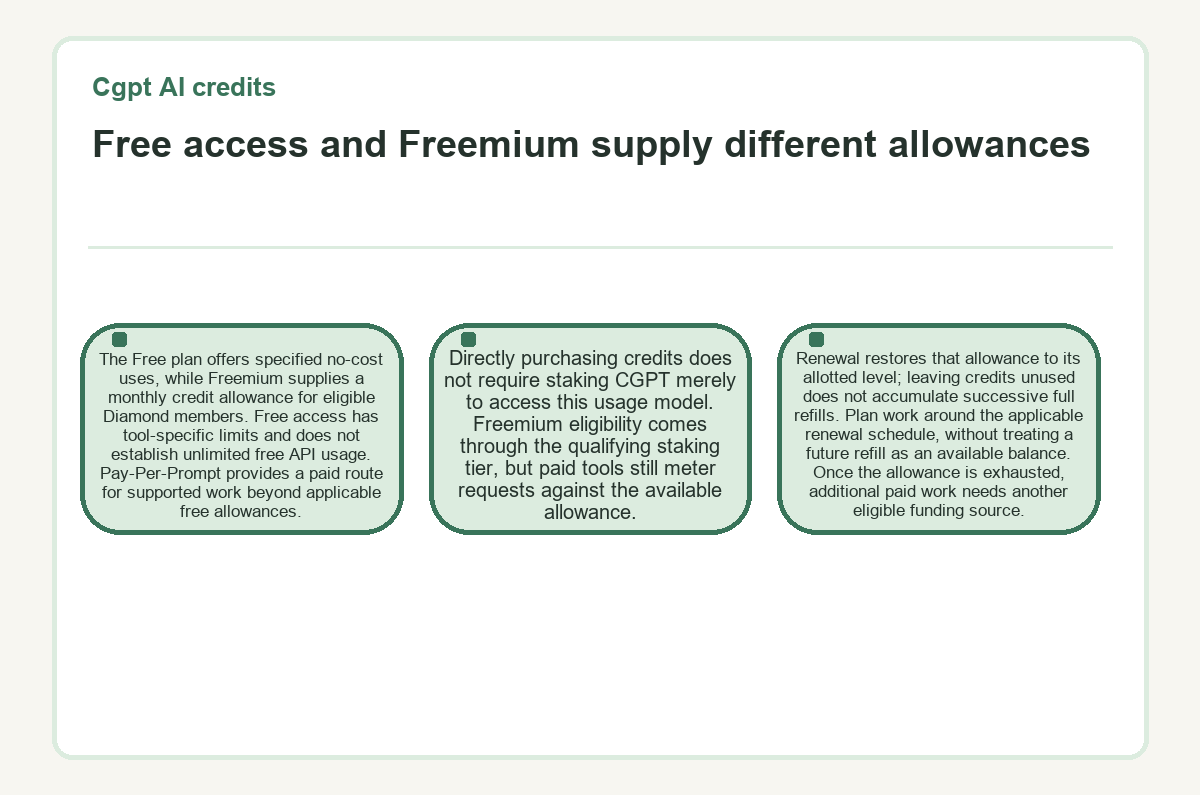
Freemium eligibility comes through the qualifying staking tier, but paid tools still meter requests against the available allowance. Renewal restores that allowance to its allotted level; leaving credits unused does not accumulate successive full refills. Plan work around the applicable renewal schedule, without treating a future refill as an available balance. Once the allowance is exhausted, additional paid work needs another eligible funding source.
Budget by operation and enabled extras
A usage budget adds each operation’s base charge and enabled extras across the work actually requested. For identical requests, total credits equal the request count multiplied by the complete credit charge per request. Mixed workloads need separate subtotals for chat, contract operations, images and news calls.
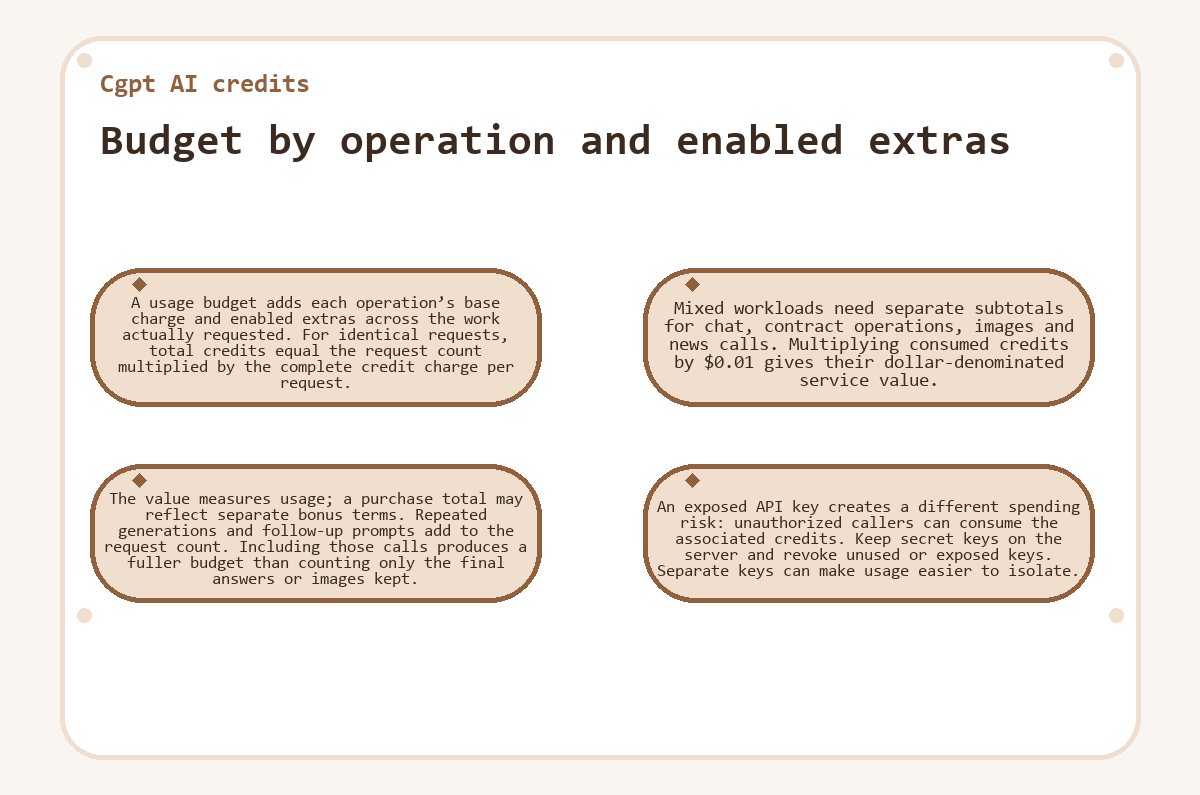
Multiplying consumed credits by $0.01 gives their dollar-denominated service value. The value measures usage; a purchase total may reflect separate bonus terms. Repeated generations and follow-up prompts add to the request count. Including those calls produces a fuller budget than counting only the final answers or images kept.
An exposed API key creates a different spending risk: unauthorized callers can consume the associated credits. Keep secret keys on the server and revoke unused or exposed keys. Separate keys can make usage easier to isolate.
Chatbot parameters separate memory from custom context
The chatbot request distinguishes the chosen model, prompt, saved memory, conversation identifier and custom context. The history switch enables saved conversations and the associated surcharge; the remaining fields select or shape the request. The following values apply to the chatbot API, rather than every tool sharing the credit system.
| Request parameter | Documented value | Effect or requirement |
|---|---|---|
model
|
general_assistant
|
Selects the general chatbot model |
question
|
Required string | Supplies the prompt sent to the AI service |
chatHistory
|
on
or
off; default
off
|
Enables saved conversation memory when on |
sdkUniqueId
|
Optional string | Groups history by conversation or user |
useCustomContext
|
true
or
false; default
false
|
Controls use of custom context |
The history value is a string, while the custom-context switch is a boolean. A conversation identifier organizes stored exchanges; authentication still requires the account’s secret API key.
Why can a funded API request still fail?
A funded request can still fail because authentication, request format, rate limits and service availability operate separately from its credit balance. Available credits cannot correct an invalid key or missing required field.
For the chatbot API, HTTP 401 identifies missing or invalid authentication. HTTP 400 can indicate malformed request data or absent required fields. The request’s error message identifies the relevant fault more precisely than the account balance.
If the available service balance cannot cover a call, the API rejects it for insufficient credits. Rate limiting concerns submission frequency, and server errors concern service execution. These conditions need different handling: slower submission addresses throttling, while corrected credentials address authentication.
Returned content and credit consumption also describe different outcomes. An interrupted stream can leave only part of an answer, even though some text appeared. Preserve the error and delivery status alongside usage records, without treating a balance change as proof of a complete response.
Automatic top-ups and manual funding suit different budgets
Automatic monthly top-ups repeat credit purchases on a recurring schedule, while manual purchases keep each funding authorization separate. An automatic purchase arrangement differs from a Freemium allowance: one spends funds to replenish credits, while the other depends on qualifying membership. Review the recurring amount and schedule against expected usage between refills.
A recurring purchase does not promise that credits will remain sufficient throughout the month. Actual consumption still follows the selected tools and options. Manual funding offers a separate decision before each purchase and suits spending controlled one authorization at a time. Automatic monthly funding reduces repeated purchase work when recurring replenishment is useful, provided its ongoing payment terms fit the intended budget.
Cgpt AI credits FAQ
Does retrieving a saved smart contract audit cost credits again?
Retrieving saved audit records through the Smart Contract Auditor’s getChatHistory method does not consume additional credits. The history surcharge applies when an audit request saves the conversation. Retrieval requires an existing saved record; it does not create a new audit or generate fresh findings.
Can purchased AI credits remain available between monthly allowance resets?
Purchased AI credits do not expire under the credit purchase model. The Freemium monthly allowance follows separate refill rules and does not accumulate successive full allocations.
Why did a CGPT payment leave my wallet without adding credits?
A wallet payment record alone does not establish that credits were added to your ChainGPT account. If the CGPT payment completed and the credit balance is unchanged, support needs the connected wallet address and purchase transaction hash. Do not repeat the payment during investigation; these cases receive individual review without an automatic refund.
Which purchases can qualify for bonus AI credits?
Eligible CGPT payments and automatic monthly credit purchases can qualify for bonus credits. A bonus increases the service balance delivered with the purchase; it does not change each credit’s dollar denomination. Check the applicable bonus terms before authorizing payment, without assuming every available payment method carries the same offer.
Is a blocked NFT image generation request always free?
A non-compliant NFT image request may consume credits without producing an image. Content filtering and credit metering are separate parts of the service, so a blocked result does not establish a free attempt. Keep prompts within the image tool’s content requirements before submitting a paid generation request.